
Westminster Medal and Physics Gold for Ané at STEM for Britain

Ané Kritzinger has won the Westminster Medal at STEM for Britain 2026, the competition’s overall prize, after receiving the Gold Medal in the Physics category. This marks a significant milestone as these are the first times a researcher from the School of Physics and Astronomy at St Andrews has secured either the Physics Gold or the overall Westminster Medal since the competition began in 1997.
STEM for Britain is a scientific poster competition held annually in the Houses of Parliament and brings together early-career researchers from across the UK to present their work to Members of Parliament and expert judges. The competition has been held in Parliament since 1997 and spans five disciplines: physics, chemistry, engineering, mathematics, and biology. Each discipline awards a Gold Medal to its outstanding presenter, and Ané took the Physics prize. She then went on to receive the Westminster Medal, awarded to the gold medal winner, across all disciplines, whose research best communicates its science to a non-specialist audience.
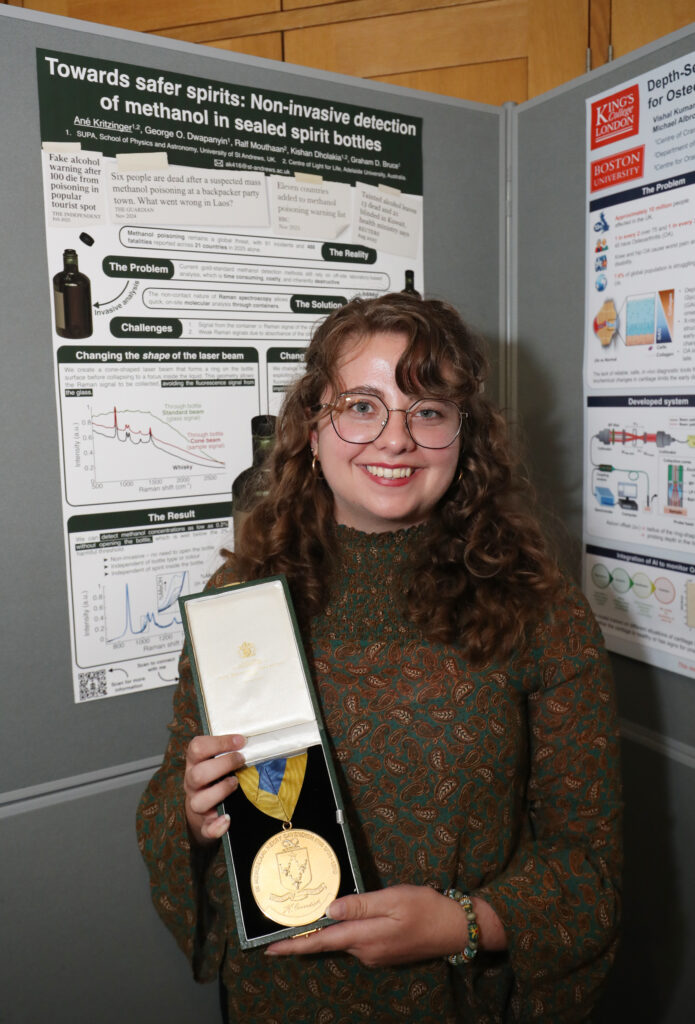
Ané’s research addresses a pressing global public health problem – methanol poisoning. Methanol poisoning from counterfeit and adulterated alcohol claimed nearly 500 lives across 21 countries in 2025 alone. Current testing methods require bottles to be opened and samples sent to a laboratory, making them slow, expensive, and impractical for large-scale screening.
Her technique uses Raman spectroscopy, a laser-based optical method, combined with two key innovations. First, the laser beam is reshaped into a hollow cone that focuses inside the liquid, bypassing the fluorescence emitted by the glass. Second, measurements taken at slightly different wavelengths allow the Raman signal of the liquid to be separated from background noise, improving the signal-to-noise ratio. Together, these advances allow methanol to be detected at concentrations as low as 0.2% through an unopened bottle, well below the 2% level associated with health risks. Beyond alcohol safety, the platform has broader potential for non-destructive chemical analysis across the food, pharmaceutical, cosmetic, and security industries.
Ané said: “By using a few physics tricks, we can make sure what people are drinking is safe, without breaking the seal. The setup is currently still in the lab, but the fact that it works through commercial sealed bottles, regardless of bottle colour and spirit type, gives it genuine potential for real-world deployment.”
The research was conducted at the University of St Andrews in collaboration with Adelaide University in Australia. Co-authors include Dr George Dwapanyin, Dr Ralf Mouthaan (Adelaide University), Dr Graham Bruce, and Professor Kishan Dholakia.
Links:
- A preprint of the research is available at arXiv:2510.06593.
- STEM for Britain website: https://stemforbritain.org.uk/.
- See motion submitted by parliament: https://edm.parliament.uk/early-day-motion/65486/an%C3%A9-kritzinger-physics-gold-medal-at-stem-for-britain-awards.